

The Law of Accelerating (Bond) Returns
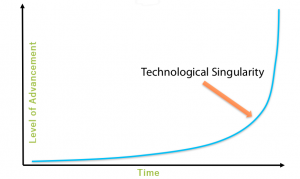 Optimistic Futurists spend a lot of time talking about how great things will be when we can apply computer science techniques to messy problems like biology, the environment, and the economy. The rate of progress in these intractable areas will explode like Moore’s Law once we can measure and manage data more effectively. These optimists might add the “messy” bond market to that list of areas ripe for improvement.
The basic Futurist idea is that, for example, if we could use better sensors and computational analysis to see what is happening with every cell in the human body, we could change medicine from a trial and error discipline into a true Computer Science. Computer Science advances at a rapid rate, with Moore’s Law implying an annual doubling in computational power. Growth this fast is exponential rather than linear. So we could hope for magical improvements in medicine in the next thirty years. But the possibility of such an advance hinges on better measurement and data. If we can’t see and analyze the data at a molecular and cellular level, biology will remain a dark art.
At first glance, the Bond Market already seems very much informed by Computer Science techniques. Bond investors build very precise analytics and valuation tools. They operate with very careful numeric frameworks as compared with the more intuitive “story-telling” that is a part of stock investing. They receive lots and lots of data.
But like biology, there are important parts of the data sets in bonds that remain hidden from view, and this is where DealVector comes in. Bond investors are limited in their ability to make good decisions, and trading remains something of a “dark art” because there is no central registry of financial asset holdings. The architecture of finance, DTC, surprisingly does not actually provide such a registry. Instead, there are a variety of custodial silos of information with limited rights of access. So investors are like doctors that can’t see into what is going on with organs or cells. If they could, they would be able to make much better decisions with respect to liquidity, with respect to enforceability of rights, and with respect to relative value. When that happened, the cost of capital for corporate america would go down. A global registry of financial asset holders will actually lead to more business, to more trading, and to more efficient allocations of capital.
The “body” of the financial economy will become much healthier!
